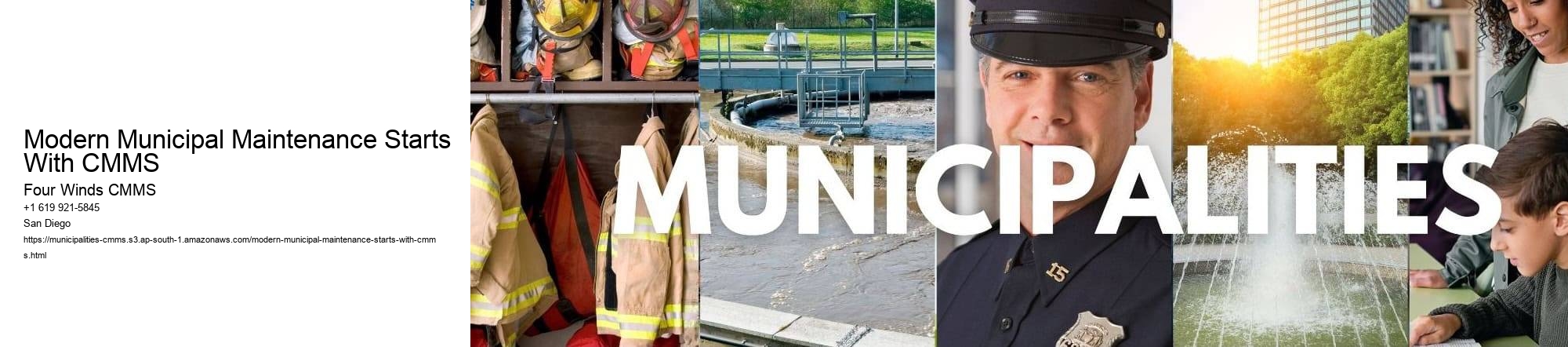
Modern Municipal Maintenance Starts With CMMS

Modern Municipal Maintenance Starts With CMMS

Infrastructure teams prefer tools that support proactive maintenance.

Managing municipal assets and maintenance operations has become increasingly complex for city governments and public works departments across the United States. A modern Municipalities-CMMS provides the structure and visibility needed to keep city infrastructure running smoothly. Outdated maintenance methods often lead to missed tasks and unexpected failures, which a Municipalities-CMMS helps eliminate.


Maintenance reports provide leaders with clear insights.

  • Infrastructure teams prefer tools that support proactive maintenance.
  • Maintenance reports provide leaders with clear insights.
  • Government CMMS Solution San Diego CA

Public works departments oversee critical infrastructure that must remain safe and operational. A Municipalities-CMMS helps organize these assets into a single system where maintenance history, schedules, and performance data are easy to access. This level of organization helps teams shift from reactive maintenance to preventive maintenance, reducing costly emergencies.

Maintenance tasks are easier to manage when work orders are tracked digitally. Maintenance reports provide leaders with clear insights. Supervisors can prioritize tasks while technicians receive clear instructions through a centralized system. Mobile-friendly access supports faster response times and more accurate reporting.

Municipalities must meet regulatory requirements related to safety, inspections, and maintenance documentation. Accurate documentation reduces compliance risk and administrative burden. Having reliable records readily available supports accountability and transparency across municipal departments.

Unexpected maintenance costs can strain public sector budgets. Better planning leads to more efficient use of labor and materials. Clear cost visibility supports smarter financial decisions.
Cross-department collaboration is essential for efficient public works management. A Municipalities-CMMS creates a shared platform where departments can work together without confusion. Department-level visibility supports better performance.

Four Winds CMMS is designed specifically for the needs of municipalities and public works departments. Ease of use ensures adoption across teams without extensive training. Growth becomes manageable with a flexible CMMS.

Municipal services depend on consistent maintenance practices. Better maintenance leads to fewer disruptions and improved public trust. Municipalities-CMMS . Government CMMS Solution San Diego CA Public works teams gain confidence in their operations.

Modern cities require smarter maintenance tools. Future-ready municipalities invest in structured maintenance platforms. Municipal teams gain clarity, control, and consistency through a dedicated CMMS solution.

Municipalities-CMMS

Municipalities-CMMS is built to support the real maintenance needs of city governments and public works departments that manage complex public assets every day. From roads and utilities to fleets, facilities, and public infrastructure, Municipalities-CMMS provides a centralized system that helps municipalities plan maintenance, track work orders, and maintain compliance without relying on outdated tools. By bringing asset data, preventive maintenance schedules, and service history into one platform, Municipalities-CMMS helps municipal teams reduce downtime, control costs, and improve long-term infrastructure reliability. This focused approach allows city operations to move from reactive fixes to proactive maintenance, creating safer communities and more efficient public services.

Public jobs are a broad category of framework tasks, funded and procured by a government body for leisure, employment, and health and safety utilizes in the higher neighborhood. They consist of public buildings (courts, colleges, and hospitals), transportation facilities (roads, railroads, bridges, pipelines, canals, ports, and airports), public rooms (public squares, parks, and coastlines), civil services (water supply and treatment, sewer treatment, electric grid, and dams), environmental protection (alcohol consumption water security, dirt disintegration decrease, wildlife environment preservation, conservation and reconstruction of forests and wetlands) and other, typically long-lasting, physical possessions and centers. Though often compatible with public framework and public capital, public jobs does not always lug an economic component, consequently being a wider term. Construction might be carried out either by straight utilized labour or by a private operator. Public works has actually been encouraged since antiquity. The Roman emperor Nero urged the building and construction of different facilities tasks throughout extensive deflation.

.

Possession administration is a systematic strategy to the administration and realization of all worth for which a group or entity is responsible. It may apply both to concrete assets (physical objects such as intricate procedure or manufacturing plants, facilities, buildings or devices) and to intangible properties (such as intellectual property, a good reputation or economic possessions). Property administration is an organized process of creating, operating, preserving, upgrading, and throwing away assets in the most cost-effective way (including all prices, risks, and efficiency qualities). Concept of possession management mainly handles the routine matter of enhancing, preserving or in various other circumstances ensuring the financial and capital value of a property over time. The term is commonly utilized in engineering, business world, and public framework sectors to make sure a coordinated strategy to the optimization of costs, dangers, service/performance, and sustainability. The term has generally been made use of in the monetary market to explain individuals and business that handle financial investments in behalf of others. Those consist of, as an example, financial investment managers that take care of the possessions of a pension fund. The ISO 55000 series of standards, developed by ISO TC 251, are the global criteria for Asset Monitoring. ISO 55000 supplies an introduction and requirements specification for a management system for property management. The ISO 55000 standard defines an asset as an "product, thing or entity that has potential or actual worth to a company". ISO 55001 specifies requirements for a possession monitoring system within the context of the organization, and ISO 55002 gives guidelines for the application of a possession monitoring system, according to the demands of ISO 55001.

.

A job order is usually a task or a work for a client, that can be set up or appointed to a person. Such an order might be from a consumer request or produced internally within the company. Job orders may also be developed as adhere to ups to examinations or audits. A job order might be for service or products. A work order should consist of the following: Requestor Day of demand Request details Location Preferred conclusion date Priority degree Job accepted by Summary of finished job Job completed by Date of completion In a production setting, a job order is converted from a sales order to reveal that job is about to begin on the manufacture, building or design of the items requested by the customer. In a service atmosphere, a work order can be equivalent to a solution order where the WO documents the area, day and time the solution is performed and the nature of job that is done. The kind of workers (e. g. job placement) might additionally be noted on the WO. A price (e. g. $/ hr, $/ week) and additionally the complete variety of hours functioned and overall worth is additionally shown on the work order. A job order may be a maintenance or repair service request from trainees, faculty or team in an university. Orders got from outside a company are usually dispatched (reviewed and set up) prior to being implemented. Job orders may be for precautionary upkeep Specialists may utilize a single job work order and invoice develop which contains the client information, describes the work done, lists costs for product and labor, and can be provided to the consumer as a billing. A work order is an interior paper extensively made use of by projects-based, manufacturing, building and manufacture services. A work order may be for products and/or services. In a manufacturing atmosphere, a task order is used to signal the start of a manufacturing process and will certainly most probably be linked to a costs of material. For this reason, the work order will possibly state: the quantity of the product to be manufactured, constructed or produced the amount of raw material to be made use of, its rate and amount the kinds of labour required, price (per hour or each) and amount the maker exercise for each equipment during the routing process, its price and quantity In a service environment, a task order can not be the equal to a job or service order where the task order records the area, date and time the service is executed and the nature of solution that was executed, the job order does not. The type of workers (e. g. work placement) may also be provided at work order. A rate (e. g. $/ human resources, $/ week) and additionally the complete variety of hours functioned and total value is also shown.

.

Software program as a solution (SaaS) is a cloud computing service model in which a provider provides software to customers while handling the needed physical and software application sources. SaaS applications are accessed through either an internet application or locally-installed software. Unlike other software program delivery versions, SaaS separates "the property and ownership of software from its usage." SaaS usage began around 2000, and by 2023 was the primary kind of software application release. Unlike many self-hosted software, just one variation of the software program exists and only one operating system and arrangement is supported. SaaS products generally work on rented out infrastructure as a service (IaaS) or platform as a solution (PaaS) systems consisting of hardware and in some cases operating systems and middleware, to fit rapid increases in use while supplying instant and continual schedule to consumers. SaaS consumers have the abstraction of limitless computer resources, while economy of scale drives down the cost. SaaS architectures are generally multi-tenant; usually they share sources between clients for performance, but sometimes they provide a siloed atmosphere for an extra charge. Common SaaS income designs include freemium, registration, and usage-based costs. Unlike conventional software program, it is seldom feasible to purchase a continuous permit for a certain version of the software application. There are no particular software program development practices that identify SaaS from other application development, although there is usually a focus on regular screening and launches.

.

The technical meaning of upkeep includes useful checks, servicing, fixing or changing of needed devices, devices, equipment, building infrastructure and sustaining energies in industrial, company, and domestic installments. Terms such as "predictive" or "prepared" maintenance describe different affordable practices focused on keeping equipment functional; these tasks take place either before or after a prospective failing.

.

About San Diego

Frequently Asked Questions

Municipalities-CMMS is designed specifically for city governments and public works departments that manage public assets such as roads, utilities, fleets, parks, and facilities. Unlike generic CMMS tools, it supports municipal workflows, compliance requirements, and multi-department coordination, making it better suited for public sector operations.

Municipalities-CMMS can be used by public works departments, water and wastewater teams, fleet management, parks and recreation, facilities management, utilities, and city infrastructure teams. Multiple departments can work within the same system while maintaining clear responsibility and visibility.

By enabling preventive maintenance and better planning, Municipalities-CMMS helps municipalities avoid costly emergency repairs and unplanned downtime. Tracking labor, parts, and asset performance also allows city leaders to make informed budget decisions and extend asset life.

Yes, Municipalities-CMMS keeps detailed records of inspections, maintenance activities, and service history. These records help municipalities meet compliance requirements related to safety and regulatory standards and make audit preparation easier and less stressful.

Municipalities-CMMS is designed with simplicity in mind. Field technicians can access work orders, update tasks, and record maintenance activity using mobile devices, reducing paperwork and improving accuracy without requiring extensive training.

Implementation is typically straightforward and faster than traditional enterprise systems. Most municipalities can begin using Municipalities-CMMS quickly without complex IT infrastructure, allowing teams to see benefits in a short time.

Yes, Municipalities-CMMS is ideal for small to mid-sized municipalities that need powerful maintenance management without unnecessary complexity. The system is scalable, meaning it can grow alongside municipal operations as asset portfolios and teams expand.